
Ehlers-Danlos Syndrome
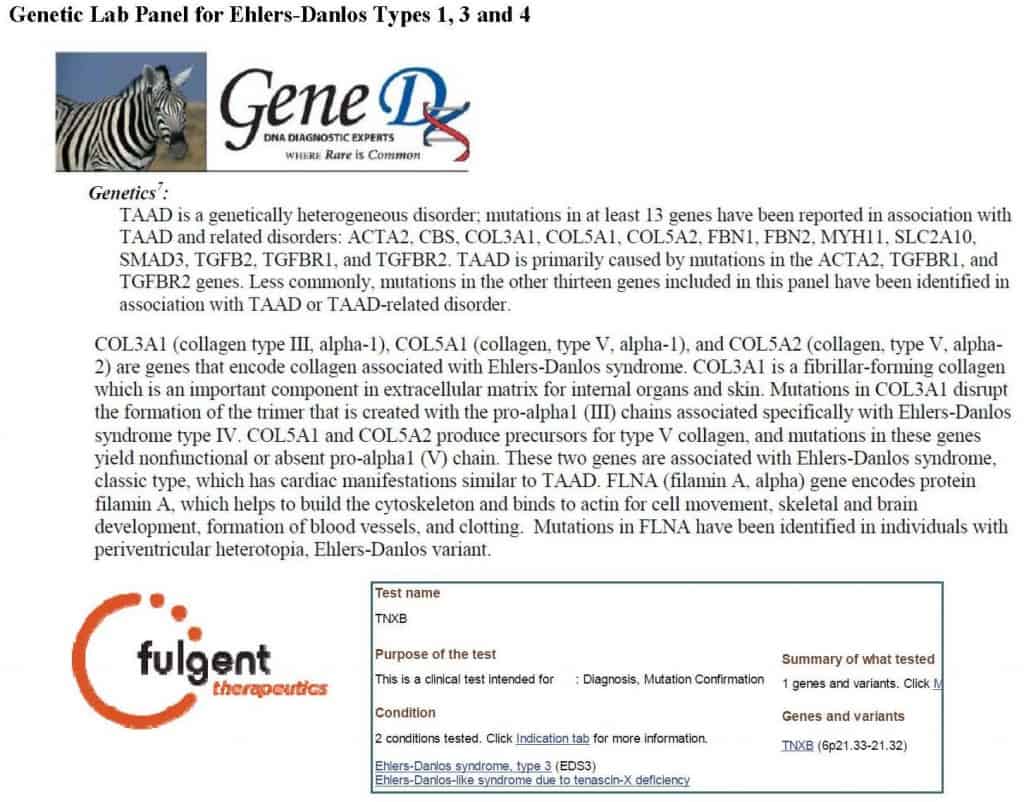
There is a strong connection between Ehlers-Danlos and POTS. This is mainly with the hypermobility type (Type 3) and vascular type (Type 4). Type 3 has joint hypermobility with frequent dislocations as hallmarks and is associated with defects in the COL3A1 or the TNXB gene. Type 4 is autosomal dominant affecting the COL3A1 gene. These have high risk of vascular complications including dilation of the descending aorta, and easy bruisability.
Ehlers-Danlos is also strongly associated with chiari malformation and therefore there needs to be high suspicion of any patient whose symptoms appear to be more consistent with a basilar mass than dysautomomia. For example, the patient may have typical extremity paresthesias and incontinence but also have patellar hyper-reflexia and increased lower extremity tone. A Head MRI is indicated in this case. Co-consultation with a neurologist, neurosurgeon and orthopedic surgeon is advised.

MRI of patient with Ehlers-Danlos

MRI of patient with Chiari Malformation
Visit: Beighton Criteria
Visit: Ehlers Danlos National Foundation
Mast Cell Activation Syndromes
Rarely a patient may present with symptoms of syncope that seem to be secondary to a noxious stimuli (smell of chemicals or smoke etc) or are associated with urticaria. Work-up of these patients might include measure of serum total tryptase and other markers of massive mast cell activation. Patients with suspected MCAS often have other allergy/immunology issues and therefore may benefit from co-consultation with an allergist.
Abdominal Vascular Compression Syndromes
- Median Arcuate Ligament Syndrome
- Superior Mesenteric Artery Syndrome
- Nutcracker Syndrome
More information coming soon
Lyme’s Disease
More information coming soon